The Quiet Teachers
The Quiet Teachers
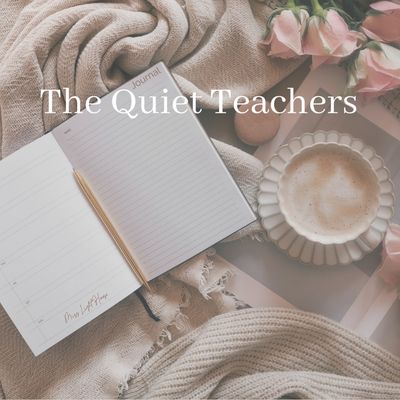
In the early hours of the morning, when the world is still half-asleep, I wrap my hands around a warm mug of coffee and let the silence settle in. There’s a softness in these moments, a space where my breath slows and my thoughts stop jostling for position. I might open my journal and let the pen wander, following threads of memory or inspiration. Some days, words tumble out quickly as I make gentle plans for what lies ahead. Other days, the writing slows until the lines blur, and I realize I’ve drifted into meditation without meaning to.
This quiet ritual has become my meeting place with the ones I call “the quiet teachers.” These teachers don’t announce themselves. They don’t arrive with trumpets or breaking news. They never shove their wisdom into your hands. Instead, they slip into the edges of your awareness, waiting patiently for you to pause long enough to notice them.
One recent morning, I found myself in the garden, utterly caught by the beauty of a single flower. Its petals unfolded in perfect harmony, each line and curve a mirror of the next. I noticed the patterns, the way the symmetry seemed to breathe, and recognized the sacred geometry nature had woven into its design. For a long while, I couldn’t look away. In its quiet way, the flower was speaking to me without words, reminding me that wisdom isn’t always about seeing things for what they first appear.
The quiet teachers take many forms. They can be the sudden shift in the wind mid-walk, carrying the faintest scent of rain. They can be the blue jay that lands a few feet away, tilts its head, and seems to ask you a question you can’t quite hear but somehow understand. They can be the flicker of candlelight in a dim room, pulling your attention into a soft, wordless trance.
These teachers are patient. They have no lesson plan, no timeline. Their only requirement is that you be present enough to meet them where they are. And when you do, something inside begins to change. The racing thoughts quiet. The edges soften. The heart opens just a little more.
I’ve come to understand that the wisdom they offer isn’t always about answers. More often, it’s about the practice of listening with the eyes, the heart, the soul. Sometimes it’s about noticing the details you usually rush past: the way the sunlight moves across the wall, the sound of leaves brushing against each other, the small pulse of life in something you thought was still.
Growth, I’ve learned, doesn’t always look like forward motion. It can look like stillness. It can look like the moment you set your coffee down, lean back, and let yourself be held by the quiet.
The quiet teachers are always around us. The question is, will we slow down long enough to be their student?
May Light guide you always,
Andra
Journal Prompts: Meeting Your Quiet Teachers
- Recall a time when nature spoke to you without words.
What did you see, hear, or feel in that moment? How did it change your mood, perspective, or understanding of something in your life? - Notice the quiet teachers in your everyday routine.
Over the next few days, keep a small list in your journal of subtle moments that feel like they’re offering a lesson — a glance, a sound, a pause. What patterns do you see emerging? - Reflect on the role of stillness in your growth.
When have you experienced transformation or clarity not through action, but through pausing? What allowed you to soften enough to receive?
The Quiet Teachers Part II
The Quiet Teachers Part II
The mind loves immediacy. It seeks answers that land with certainty and wrap the whole story in a neat ribbon. But wisdom doesn’t always arrive on demand. In fact, some of the most meaningful guidance comes through the smallest moments—then returns later, softened by time, ready to be understood in a new way.
I’ve come to notice that the quiet teachers don’t only speak in the moment. Sometimes they meet me again when I return to the page.
A few days later, I’ll re-read a line I wrote without thinking—something ordinary, almost forgettable—and suddenly it glows with meaning, because the words changed…no... but because I did. Something in me shifted slightly. This is one of the quiet miracles of journaling: it holds your life still long enough for you to see it.
The wisdom you can’t force
There’s a particular kind of frustration that comes when you’re doing “all the right things”—reflecting, praying, meditating, trying to understand—and still, the clarity won’t come. Your mind keeps circling the same question, hoping that if you think hard enough, you’ll finally arrive at the clean, definitive conclusion.
But some truths will only show up after a little space. It's as if they need a little air in between days. That’s why the return matters. The return is where the quiet teachers often reveal themselves.
When you write, you’re not only capturing what you know. You’re capturing what you don’t know yet—what you’re sensing, what you’re carrying, what you’re trying to name. You’re leaving a trail for your future self. And later, when you come back, you’re able to see what was actually happening beneath the surface.
The page as a time capsule
A journal is more than a place to vent or process. It’s a time capsule of your inner world that preserves the tone of a season. It keeps the emotional weather intact, and it records your instincts before your mind has the opportunity to edit them.
Sometimes I’ll stumble across a sentence I barely remember writing and realize: Oh. There it is. That was the lesson trying to arrive. Or: That’s exactly where I started shrinking. Or: That was the moment I knew… before I talked myself out of it.
And when you see that, gently and honestly, you begin to understand yourself differently. No judgment, just compassion and recognition. Because you can finally track the shift.
You can see how you moved from fear into steadiness, from confusion into quiet knowing and from contraction into expansion. Because your journal is keeping the real time receipts.
You don’t need clarity while writing
If you’ve ever avoided journaling because you didn’t know what to say, or you worried you’d sound repetitive, or you felt like your writing had to mean something—let me offer you a gentler invitation. You don’t have to write with clarity and You don’t have to make it beautiful. It doesn't need to make sense.
Sometimes the most powerful thing you can do is simply write for the sake of writing—let it be messy, unfinished, even nonsensical. Put it down on paper, on your tablet, in your Notes app—whatever your method is. Just get it out of you and onto the page. Journaling gives you a place to practice honesty.
A simple practice: “Write now, return later”
If you’d like a way to work with this, here’s a simple rhythm you can try—especially when you’re in the middle of something you can’t quite understand yet:
1) Write the raw version.
Set a timer for 5–10 minutes and write what you’re actually experiencing—without trying to solve it. If all you can write is “I don’t know what’s going on,” write that. If all you have is emotion, write that. If all you have is one sentence, let it be one sentence.
2) Leave a breadcrumb.
At the end, add one line that begins with:
- “What I think this might be teaching me is…”
- “The part of this that feels important is…”
- “The feeling I can’t ignore is…”
- “If I trusted myself here, I would…”
Remember, no pressure. Just a breadcrumb.
3) Return in three days.
Read what you wrote as if you’re reading someone you love. Don’t critique it. Don’t analyze it to death. Just notice what stands out now that you’ve lived a few more days.
Often, the meaning reveals itself in the re-reading—not in the original writing.
Prompts to help you listen for your quiet teachers
If you want a few reflection prompts for your return-to-the-page moment, try these:
- What line feels brighter now than it did when I wrote it?
- What was I protecting myself from when I wrote this?
- What truth was present, even if I couldn’t name it yet?
- What pattern is repeating here—and what is it asking for?
- If this entry had a gentle message for me, what would it be?
- What would compassion say to the version of me who wrote this?
And if you feel emotional while reading your own words, let that be part of the guidance too. Your tenderness is information.
Your light is safe
Returning to the page is an act of trust. It says: I don’t have to rush my healing. I don’t have to force my understanding. I can let life unfold and meet myself honestly along the way.
Your light is safe—even when you don’t have all the answers.
Sometimes the quiet teachers aren’t outside of you at all. Sometimes they’re inside your own sentences, waiting patiently for you to come back and finally see what you were already becoming.
Happy journaling-may the Light guide you always,
Andra


Free Guide for Soul Centered Parents
This short guide introduces seven gentle spiritual practices you can weave into everyday family life—simple moments that help children stay connected to their inner light while strengthening the bond you share.